Bristol, Tennessee
A shared downtown on the Tennessee–Virginia line, southwest on I-81.
Community guide · Tennessee
A Southwest Virginia county seat of brick sidewalks and Federal-era buildings, where a Depression-era theatre, a historic inn, an art museum in a 1913 schoolhouse and a rail-trail shape everyday life.
Long before it was Abingdon, this ridge-and-spring country was known as Wolf Hills. Local tradition credits the name to Daniel Boone and a run-in his dogs had with wolves in 1760, a story best enjoyed as legend. What is documented is that settlers arrived in the 1760s and 1770s under purchases from the surveyor Dr. Thomas Walker, and that Joseph Black built a fort here in 1776. In 1778 the Virginia General Assembly established the town as the seat of the new Washington County.
For much of the next century Abingdon was a leading legal and commercial center for Southwest Virginia, and its buildings show it: Virginia's historic-resources records note an unusually large concentration of Federal and antebellum brick for the region. During the Civil War, Union troops under General George Stoneman struck the town; the railroad depot burned and was rebuilt, and part of that rebuilt complex survives today as the Arts Depot.
Two of Abingdon's best-known landmarks face one another on West Main Street, and together they say a great deal about the town.
On June 10, 1933, in the depths of the Depression, Robert Porterfield opened Barter Theatre with a simple proposition: admission was 35 cents or its equivalent in produce. Its opening slogan put it plainly: "With vegetables you cannot sell, you can buy a good laugh." In 1946 Barter became the State Theatre of Virginia, the first professional theatre to receive that designation.
The main theatre occupies a building whose earliest known performance dates to 1876. Across the street, the smaller Smith Theatre occupies an 1829 building that began as a Methodist church. Productions run through much of the year.
The core of the building was constructed in 1832 as a residence for General Francis Preston and his family. It later housed Martha Washington College, and it opened as a hotel in 1935, according to the inn's own history. Today it stands directly across Main Street from Barter Theatre.
These are cultural landmarks, linked here for history and visiting information; no affiliation is implied.
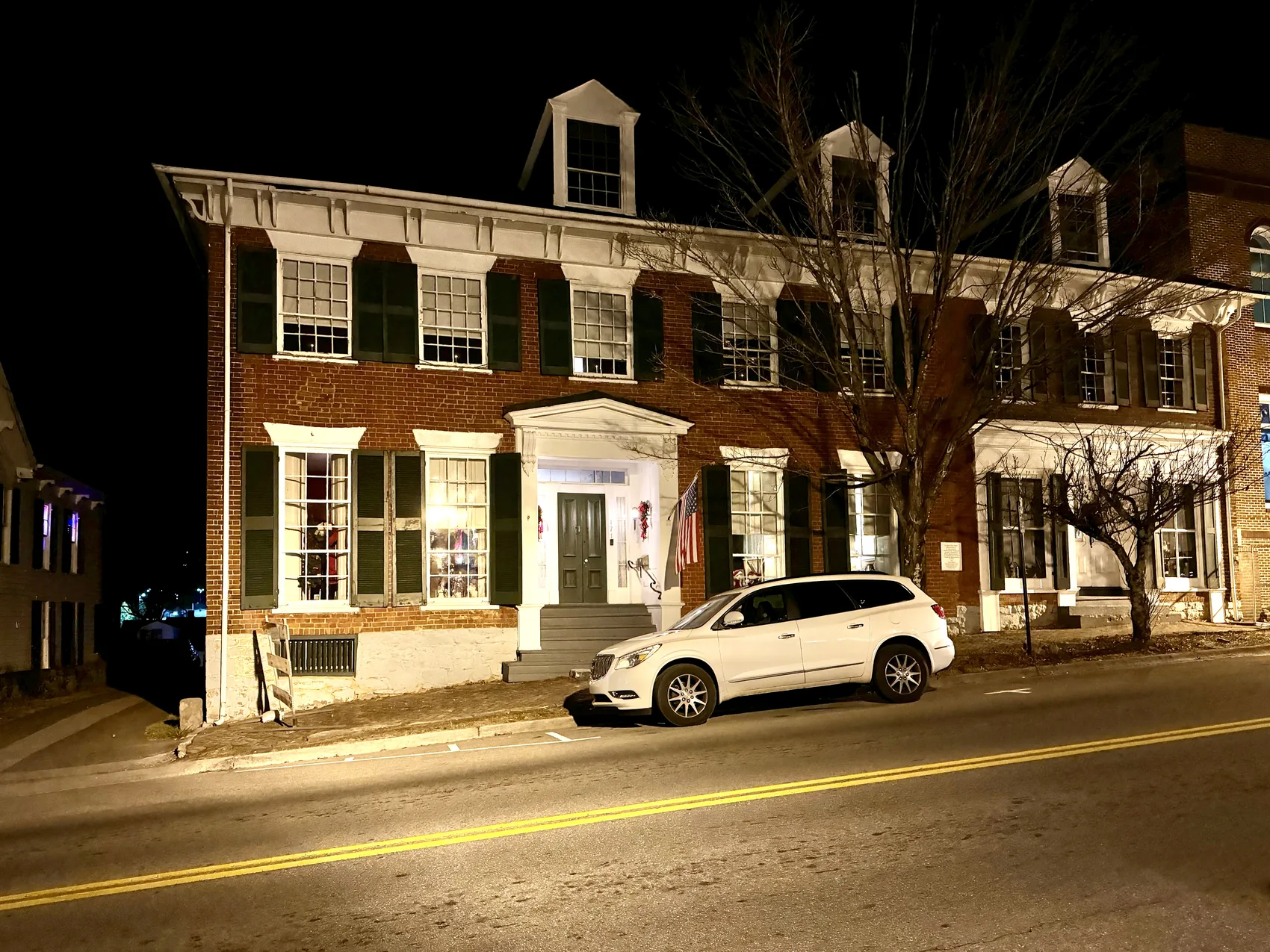
Abingdon's Main Street is best experienced slowly. Brick sidewalks run past Federal townhouses, Greek Revival columns, Queen Anne porches and Victorian storefronts, many of them inside the Abingdon Historic District. The district was listed on the Virginia Landmarks Register in 1969 and the National Register of Historic Places in 1970, with 145 contributing buildings.
The Tavern, at 222 East Main Street, built of hand-cut limestone below and log above, is often described as one of the oldest standing buildings in town; sources differ on its exact construction date.
Visit Abingdon: historic Main Street · Virginia DHR: Abingdon Historic District
A 1913 school building on land donated by William King, saved by a community effort that began in 1979. The museum opened in 1992 on a hilltop campus of roughly twenty acres, with exhibitions of regional and visiting art.
The freight station the railroad added in 1870, after the depot burned in the Civil War. The Town bought the property after it closed in 1981, and artists moved into renovated studios and galleries in 1990.
The Virginia Creeper Trail begins at Abingdon's trailhead on Green Spring Road, near downtown, where a historic steam locomotive stands on display. The rail-trail follows a former railroad corridor through farmland, woods and river valleys toward Damascus.
As of October 15, 2026, the Abingdon-to-Damascus section, about 17 miles, is open. The Damascus-to-Whitetop section, heavily damaged by Hurricane Helene in September 2024, remains closed for reconstruction, with no access beyond Damascus. In July 2026 the U.S. Forest Service announced a planned reopening on March 31, 2027; treat it as a plan rather than a guarantee and check before you go.
Abingdon's historic appearance is protected through local review. In the Town's historic preservation districts, exterior changes visible from a public right-of-way require a Certificate of Appropriateness from the Historic Preservation Review Board, formerly the Board of Architectural Review, before work begins. The Board applies the Town's Design Review Guidelines, based on the Secretary of the Interior's Standards for Rehabilitation, and has reviewed doors, windows, fencing, additions, paving and siding.
Review applies only to properties in the mapped districts and to the work the ordinance covers, not to every home in Abingdon. For any specific address, start with Town planning staff and the current zoning ordinance.
Brick and frame homes from the Federal period through the early twentieth century, some on deep, mature lots.
Post-war homes beyond downtown.
Subdivisions toward the edges of town and in the county.
Farms and rural homesites in the valleys and ridges, where wells, septic systems and access are part of the review.
Interstate 81 runs along Abingdon's edge and connects it with Bristol to the southwest and the rest of the Great Valley of Virginia. The Abingdon Visitor Center is a practical first stop for maps and information. Tri-Cities Airport in Blountville, Tennessee serves the region.
Abingdon is in Virginia, so several practical matters differ from the Tennessee communities in this series.
An Abingdon mailing address does not establish town limits. Town residents pay town and county real estate taxes.
Virginia localities assess real estate at fair market value and set their own rates. Confirm current rates with the Town and Washington County.
Virginia localities levy a personal property tax on vehicles. New residents title and register vehicles with Virginia DMV within 30 days and obtain a Virginia driver's license within 60 days.
Exterior changes in mapped districts need Historic Preservation Review Board approval.
Washington County Public Schools serves Abingdon-area addresses, including Abingdon High School; assignment is by address, so confirm the zone for the specific property with the division. Verify utilities, internet and flood status for the exact address as well. Virginia contract and disclosure practices differ from Tennessee's; we review them for any specific purchase.
Washington County Public Schools (VA) · FCC National Broadband Map · FEMA Flood Map Service Center
No. As of October 15, 2026, the Abingdon-to-Damascus section is open and the Damascus-to-Whitetop section remains closed for Hurricane Helene reconstruction, with a planned reopening announced for March 31, 2027. Check the Forest Service and the Town of Damascus for current status.
No. They apply to properties in the Town's mapped preservation districts, and to exterior work visible from a public right-of-way.
Real estate is assessed at fair market value, and rates are set locally. Homes inside town limits pay both town and county rates. Vehicles are also subject to local personal property tax.
A professional theatre founded in 1933 that famously accepted produce as admission, and since 1946 the State Theatre of Virginia.
Vehicle registration, personal property taxes, licensing and some transaction practices differ. Plan for those steps early.
If Abingdon is on your list, I'd be glad to talk through what you're looking for and the questions that come with a home in Virginia.
Talk with MarshallFacts were checked against official town, state, federal and institutional sources in October 2026. Trail conditions, schedules and tax rates change; confirm current details with the listed sources.
Historical source records; external links and facts require an updated review before production use.
Plan your next step: First-time homebuyer guide · Preparing to sell your home · Moving to the Tri-Cities · Explore community guides