Johnson City
The region's university and medical center, a short drive east.
Community guide · Tennessee
A town laid out in 1779 whose Main Street still reads like a timeline, where preservation is a working practice and storytelling is a civic tradition.
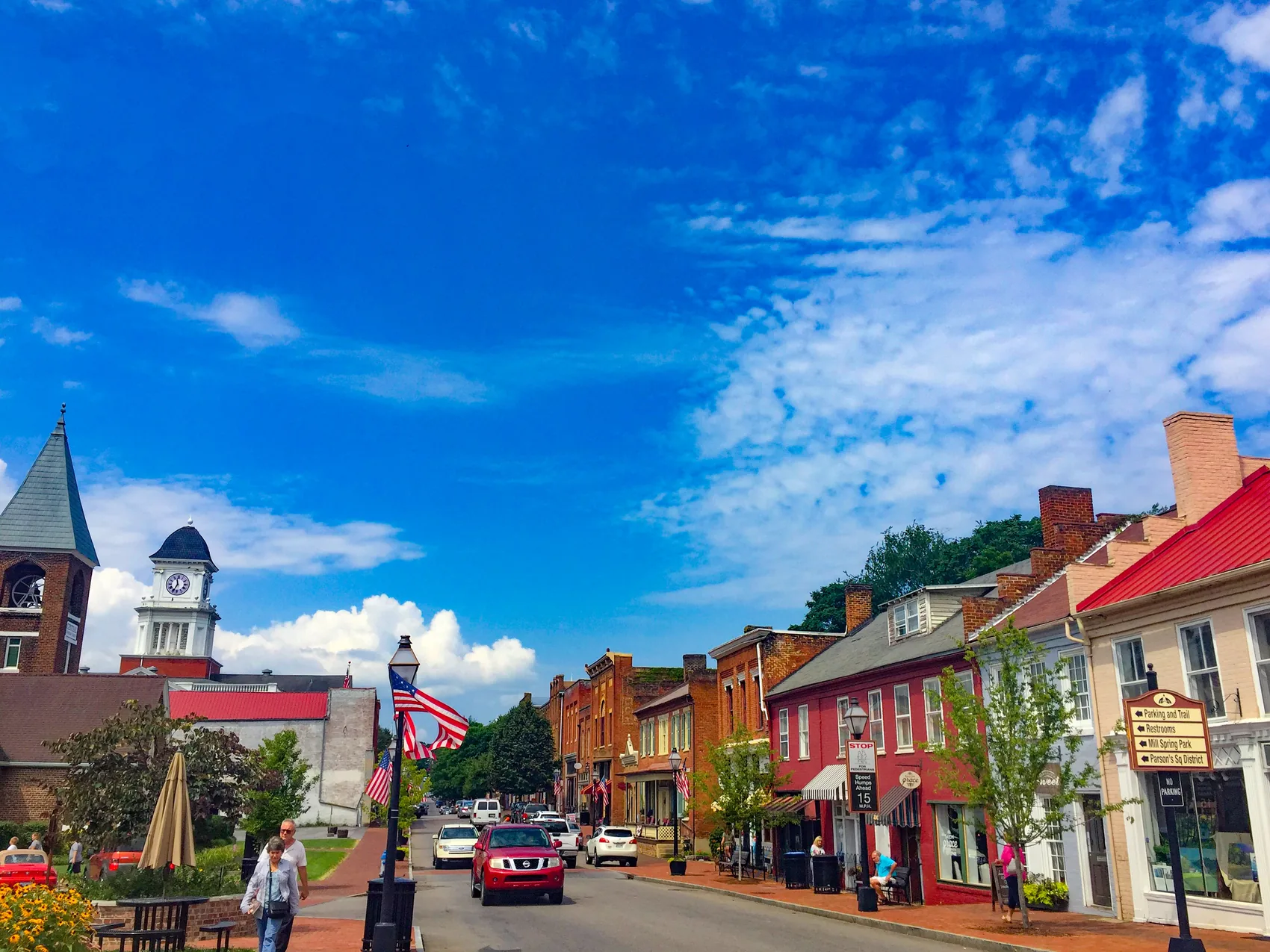
Jonesborough was established in 1779, seventeen years before Tennessee became a state. The North Carolina General Assembly created it as the seat of Washington County and named it for Willie Jones, a North Carolina legislator who supported settlement west of the mountains. When delegates met here in December 1784 to form the short-lived State of Franklin, Jonesborough served as its first capital. Congress never recognized Franklin, and the land returned to North Carolina, but the episode is part of why the town is known as Tennessee's oldest.
The record of those early decades survives in specific names. Andrew Jackson arrived in 1788 and took the oath to practice law here. In 1820 Elihu Embree began publishing The Emancipator in Jonesborough, which the Town describes as the first periodical devoted exclusively to abolition. The Town's own history also notes that Embree had been an enslaver for most of his life, a reminder that local history is more complicated than a plaque can hold.
Jonesborough's character is concentrated, which is part of its appeal. Along Main Street, Federal and Greek Revival buildings, brick commercial blocks and later Victorian storefronts share a single walkable corridor, with the Washington County Courthouse at its center. The Town's Main Street program supports the small businesses that occupy these buildings and the preservation work that keeps them in use.
The Chester Inn, built in 1797 by Dr. William Chester, is generally considered the oldest commercial building in town. It is a State Historic Site owned by the State of Tennessee, and its street-level museum, operated by the Heritage Alliance, traces Jonesborough's history from 1779 forward. The Heritage Alliance also leads guided downtown walking tours on a seasonal schedule; confirm current days and times before you go.
A short walk away, the Christopher Taylor House, a two-story log house generally dated to about 1777–1778, is a rare surviving example of the region's earliest building tradition. It was moved to its downtown site in 1974 to save it from demolition, so it is an exhibit of early construction rather than a house on its original ground.
The Town's Visitors Center offers self-guided strolling-tour maps for anyone who prefers to explore at their own pace.
Town of Jonesborough: history · Heritage Alliance museums · Main Street Jonesborough
In October 1973, Jimmy Neil Smith and fellow residents staged a gathering of storytellers on an old farm wagon in Courthouse Square for an audience of about sixty people. That first event became the National Storytelling Festival, held in Jonesborough every October since, now on the first full weekend of the month.
The International Storytelling Center, established in 1998 to carry the festival forward, anchors the tradition year-round from its downtown campus. Its Teller-in-Residence series brings a different storyteller each week through the warmer months; check the season schedule each year.
For several days each October, festival tents, visitors and street closures change downtown traffic and parking. Residents who live or work near Main Street plan around festival week, and the Town publishes closure schedules ahead of the event.
Jonesborough's preserved appearance is no accident; it is administered. Within the Town's mapped H-1 and H-2 historic zones, the Historic Zoning Commission must approve exterior work in advance.
New construction, additions, re-roofing, storm windows and doors, exterior lighting, signs and paint color. A Certificate of Appropriateness is required before a building permit for exterior work is issued.
Interior renovations in privately owned buildings are not reviewed, and the rules apply only to properties inside the mapped zones. Many homes in and around Jonesborough are outside them.
For any specific property, the Town's H-1/H-2 zones map and Town Hall are the place to confirm whether review applies. Repainting in the same color may qualify for a simpler approval; ask before you begin.
Older homes near downtown, some predating the Civil War, in brick, frame and occasional log construction, many inside the historic zones.
Houses from the late nineteenth and early twentieth centuries on the streets around Main Street.
Contemporary floor plans in subdivisions beyond downtown.
Washington County countryside where wells, septic systems and private roads can be part of the due diligence.
Each setting asks different questions of a buyer. An older home may involve preservation review, original materials and aging systems; a rural parcel may rely on a well, a septic system or a private road. We look at the particulars of each property rather than generalizing about the town.
The Town's largest park, about 130 acres, with hiking and biking trails, ball fields, a playground, a basketball court, a disc golf course and the seasonal Wetlands Water Park, typically open in summer.
Portions of the walkway run through Persimmon Ridge and Mill Spring Park near downtown.
Golden Oak, Depot Street and Stage Road parks, with pavilion rentals available through the Town.
Jonesborough sits in Washington County, west of Johnson City, with U.S. 11E among the main routes connecting the two. Tri-Cities Airport in Blountville serves the region. Downtown is compact and easy to explore on foot, but sidewalks vary outside the historic core, so we evaluate access property by property.
A Jonesborough mailing address does not establish town limits. Jurisdiction affects property taxes, services and some regulations, so we confirm it with county records and the Town.
Tennessee assesses residential property at 25% of appraised value. Homes in town pay town and county rates; homes outside pay the county rate. Use current rates from the County Trustee and the Town.
Check flood-zone status for the specific parcel rather than assuming from location.
Washington County Schools serves Jonesborough-area addresses. Schools in town include Jonesborough Elementary, Jonesborough Middle and David Crockett High School, but assignment is by address; confirm the zone for the specific property with the district. This is a directory, not a ranking.
Jonesborough was established in 1779, before Tennessee statehood in 1796, and the town identifies itself as Tennessee's oldest. Its founding date and its role as the State of Franklin's first capital are well documented.
No. They apply to properties in the Town's mapped H-1 and H-2 zones, and to exterior work such as additions, roofing, windows, lighting, signs and paint color. Interior work in private buildings is not reviewed.
Paint color is among the exterior changes the Historic Zoning Commission reviews in the H-1 and H-2 zones. Ask Town Hall before you begin.
For several days each October, festival tents, visitors and street closures change downtown traffic and parking. The Town publishes closure schedules ahead of the event.
Not necessarily. Confirm jurisdiction with county property records and the Town, because it affects taxes and services.
Whether you're drawn to a house on a historic street or a property in the surrounding countryside, a conversation is a good place to start. I can help you think through the questions that matter for a particular home, from town limits to preservation review.
Talk with MarshallFacts in this guide were checked against official town, state and institutional sources in October 2026. Event dates, hours and tax rates change; confirm current details with the listed sources.
Historical source records; external links and facts require an updated review before production use.
Plan your next step: First-time homebuyer guide · Preparing to sell your home · Moving to the Tri-Cities · Explore community guides